
What is short-term holder realized price?
Short-term holder realized price estimates the on-chain cost basis of recent holdings. Glassnode’s age-based series uses unspent outputs younger than 155 days, values each at its creation price, and divides the cohort’s realized value by its BTC amount.
Provider-specific age definition and hypothetical cohort examples; no live cost-basis level. Research methods.
What is short-term holder realized price?
Short-term holder realized price estimates the average on-chain cost basis of recent bitcoin holdings. For Glassnode’s age-based STH realized-price series, the included unspent transaction outputs are younger than 155 days. The dollar value assigned to each output reflects its creation price; the cohort’s total realized value is divided by its BTC amount. Glassnode’s market API documentation defines the series.
It is a model of recent outputs, rather than a record of each recent buyer’s actual purchase. A long-standing investor can move bitcoin between wallets and create a young output. Conversely, trading inside an exchange can change the owner without creating a new on-chain output. “Short-term holder” is therefore an analytical label, not a verified personality type.
Why 155 days, and which methodology?
Glassnode’s original UTXO research selected 155 days from the relationship between output age and subsequent spending probability. Its age-based split treats outputs younger than that threshold as short-term and older outputs as long-term. A coin does not suddenly change its owner’s intention on that day.
A separate entity-based holder-supply methodology uses an averaged acquisition date and a smooth logistic transition centered at 155 days, with a 10-day transition width. At the midpoint, the entity’s balance is weighted equally between the two cohorts. Do not apply that smooth supply classification automatically to a price series documented as a hard UTXO age filter. Match the numerator, supply definition and provider.
How is the cohort’s cost basis calculated?
STH realized price = cohort realized value
÷ cohort BTC amount
STH-MVRV = market price ÷ STH realized price
The second relationship follows when market and realized valuation use the same cohort amount. The broader MVRV and cost-basis guide explains the valuation arithmetic. Neither formula establishes a price that the market must revisit.
A rising cost basis can occur without new buying.
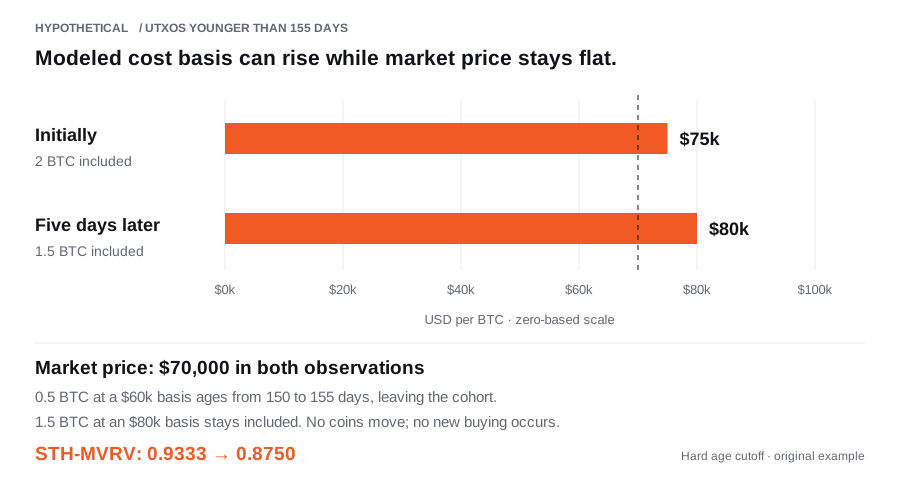
Consider an original, simplified hard-age-filter example. Output A contains 0.5 BTC, was created at $60,000 per BTC and is 150 days old. Output B contains 1.5 BTC, was created at $80,000 and is 30 days old. Both initially qualify. Their realized values are $30,000 and $120,000, giving $150,000 ÷ 2 BTC = $75,000 per BTC.
The membership changes. The market price stays flat.

| Observation | Initially | Five days later |
|---|---|---|
| Output A: 0.5 BTC at $60,000 | 150 days old; included | 155 days old; excluded |
| Output B: 1.5 BTC at $80,000 | 30 days old; included | 35 days old; included |
| Included cohort amount | 2 BTC | 1.5 BTC |
| Included realized value | $150,000 | $120,000 |
| Realized price per BTC | $75,000 | $80,000 |
| At a $70,000 market price | STH-MVRV ≈ 0.9333 | STH-MVRV = 0.8750 |
As the cheaper output ages out, the remaining cohort’s estimated basis rises by 6.7%, even though no one buys and the market price stays at $70,000. Its ratio falls from 0.9333 to 0.8750. This is a composition effect. It explains why “the cost basis rose” cannot, on its own, establish fresh demand or a new purchase price for every holder.
What does price above or below the line mean?
With matching definitions, a market price below the cohort’s realized price puts its aggregate marked value below its modeled basis. In the initial example, 2 BTC are marked at $140,000 against a $150,000 basis, a net difference of −$10,000. That aggregate conceals a $5,000 gain on A and a $15,000 loss on B.
Satswise reads the distance from the line together with its duration and the changing cohort amount. A brief crossing and an extended period below basis deserve different descriptions. Neither supplies a universal sell threshold or guaranteed support level. If an analyst calls the line “support,” ask for evidence about actual price behavior across comparable periods and the cases where it failed.
Which related indicator adds a different question?
| Measure | Question | Interpretation limit |
|---|---|---|
| STH realized price | What is the modeled basis of the included recent outputs? | A mean can conceal a wide spread of individual bases. |
| STH-MVRV | How does current price compare with that basis? | It repackages the same price and basis inputs. |
| STH-SOPR | At what profit/loss ratio did recent outputs move? | Spending is not proof of an exchange sale. |
| Holder supply | How much BTC qualifies under the chosen cohort method? | Aging and entity adjustments affect membership. |
How to use the metric in strategic research.
- Name the series: Record provider, age filter, adjustments, timestamp and currency.
- Check both inputs: Look at cohort realized value and amount, rather than treating their ratio as a complete story.
- Distinguish stock from flow: Use cost basis for outstanding holdings and SOPR for spending; keep differences visible.
- Add another mechanism: Compare with measured fund flows, leverage or liquidity within the Bitcoin market-cycle framework.
Sources and scope.
Knowledge article reviewed on 12 October 2026. Diagram and calculations are original hypothetical examples using an explicit hard age cutoff. No live STH cost-basis data or price prediction is presented. Provider definitions and Satswise’s reading framework are identified separately.
- Glassnode — STH realized price and STH-MVRV API definitions
- Glassnode — Original UTXO age split
- Glassnode — Separate entity-weighted holder-supply methodology
Updated 13 Oct 2026: Added a concise answer, evidence limits and topic reading paths. Underlying source reviews and chart observation cutoffs remain unchanged. Report a correction.