
What is Bitcoin futures basis?
Futures basis is the difference between a dated futures price and the simultaneous spot price. Positive basis places the future above spot; negative basis places it below. The gap prices exposure to an expiry and is not a direct forecast of future spot.
Worked examples use simple 365-day annualization; no live quote or recommended trade. Research methods.
What is Bitcoin futures basis?
Bitcoin futures basis is the difference between the price of a dated futures contract and Bitcoin’s spot price at the same time. A positive basis means the future is more expensive; a negative basis means it is cheaper. The gap describes the price of carrying exposure to a stated expiry, rather than providing a direct forecast of where spot will trade.
CME’s basis-trading explanation describes a trade with opposing spot and futures positions. When futures trade above spot, a trader may buy the spot exposure and short the future. That makes an important reading distinction: a futures short can hedge a long holding, rather than express an outright bearish view.
How is annualized Bitcoin basis calculated?
State the contract, observation time and days to expiry before quoting the number. In this article we use a simple, non-compounded annualization with a 365-day year:
Annualized basis = ((futures price / spot price) − 1) × (365 / days to expiry)
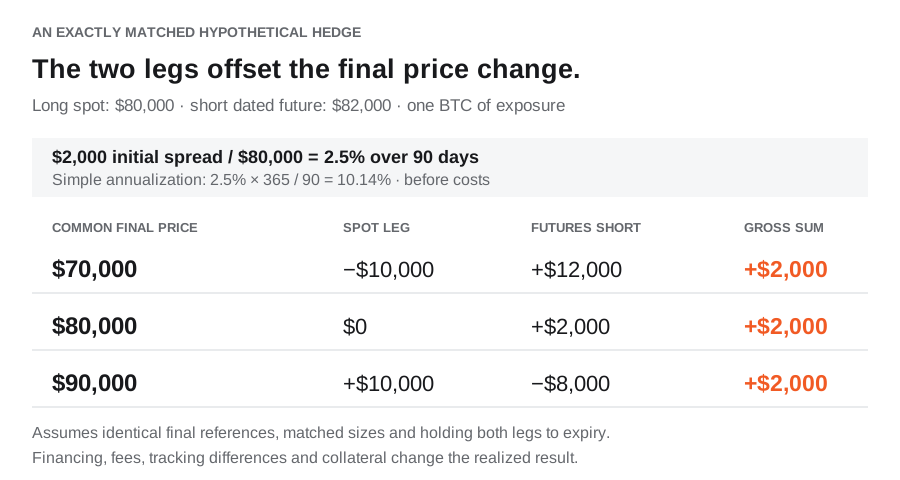
For a hypothetical $80,000 spot price and $82,000 future expiring in 90 days, the dollar gap is $2,000 per BTC. The unannualized premium is 2.5%. Multiplying 2.5% by 365/90 gives a 10.14% simple annualized basis. This is a price-comparison convention. It is not the return earned in 90 days, a net yield after costs, or a promise that another identical trade will be available.
The denominator matters. The same 2.5% premium over 30 days annualizes to 30.42%; over 180 days it becomes 5.07%. Those numbers do not represent larger or smaller dollar gaps: all three begin with $2,000 per BTC. A large annualized quote near expiry can therefore be misleading without its remaining time.
What does a cash-and-carry hedge do?
Consider one BTC of matched exposure: a hypothetical purchase at $80,000 and a simultaneous futures short at $82,000. This is a normalized teaching example, not an exchange contract specification. Assume both legs can be held to expiry, the spot sale matches the futures settlement reference exactly, and there are no costs.
At a common final price of $90,000, the spot leg gains $10,000 and the futures short loses $8,000. At $70,000, the spot leg loses $10,000 while the short gains $12,000. Under the stated assumptions, either path leaves the same $2,000 gross result.
The price direction changes the legs, not their idealized sum.

Satswise calculations. No current futures prices, ETF positions or achievable trading returns are shown.
| Common final price | Spot leg | Futures short | Combined gross result |
|---|---|---|---|
| $70,000 | −$10,000 | +$12,000 | +$2,000 |
| $80,000 | $0 | +$2,000 | +$2,000 |
| $90,000 | +$10,000 | −$8,000 | +$2,000 |
The algebra is simple: (final price − $80,000) + ($82,000 − final price) = $2,000. Cancellation depends on the final prices matching. If spot could only be sold at $89,800 while the future settled at $90,000, the gross result would fall to $1,800. A cash-settled derivative does not automatically dispose of the separate spot holding.
Why is gross basis not guaranteed profit?
For an original cost illustration, assume financing the $80,000 spot purchase costs 6% per year on a simple basis. Over 90 days that is $80,000 × 0.06 × 90/365 = $1,183.56. Assume another $200 in total trading and holding costs. The initial $2,000 spread then leaves $616.44, before costs omitted from those assumptions. Extra collateral may require additional capital; calculating a return only on the spot purchase would ignore it.
The path can matter even when the final arithmetic looks balanced. CME’s mark-to-market guide explains that futures gains and losses are settled daily. A short can need cash after a price rise while a separate long holding has an unrealized gain. Having offsetting economic exposure is different from having cash in the right account when it is required.
CME’s margin guide also describes changing margin requirements and possible liquidation if requirements are not met. Other practical questions include matching contract size, settlement benchmarks, ETF tracking and expenses, custody, execution and the cost of an early exit. These are reasons to investigate a spread, rather than label it a guaranteed yield.
Why can ETF inflows accompany futures shorts?
CME explains that a spot ETF can supply the long leg of a basis trade. An ETF purchase therefore does not reveal the holder’s complete direction of exposure. A long ETF plus a matched futures short may seek the spread; a long ETF without that hedge has a different sensitivity.
Our interpretation is to read Bitcoin ETF flows alongside dated futures basis and positioning, while keeping each dataset’s limits explicit. Aggregate inflows and aggregate shorts do not prove they belong to the same participants. If the spread narrows, a trader could unwind both legs; this is a possible mechanism, rather than an explanation for every outflow.
Finally, keep dated basis separate from perpetual funding rates. A dated future has an expiry in the calculation above. Perpetual funding is a sequence of transfers governed by a venue’s rules, and future payments can change. Annualizing a recent funding interval does not lock in that rate for a year.
Sources, assumptions and scope.
Knowledge article reviewed on 12 October 2026. Examples, diagrams and cost assumptions are Satswise’s original teaching calculations; no live basis quote or recommended trade is presented. Simple annualization uses 365 calendar days and excludes compounding. Hedge examples normalize exposure to one BTC and assume matching final prices except where a mismatch is explicitly shown.
- CME Group — Spot ETFs and crypto basis trading
- CME Group — Daily mark-to-market settlement
- CME Group — Initial margin, maintenance margin and margin calls
Updated 13 Oct 2026: Added a concise answer, evidence limits and topic reading paths. Underlying source reviews and chart observation cutoffs remain unchanged. Report a correction.