
What is the Cantillon effect?
The Cantillon effect describes how the route and timing of new money can change relative prices and distribute purchasing power unevenly. The outcome depends on who receives and spends it, which prices adjust, and how contracts and incomes respond.
Conceptual mechanism and editorial interpretation; no distributional effect is estimated. Research methods.
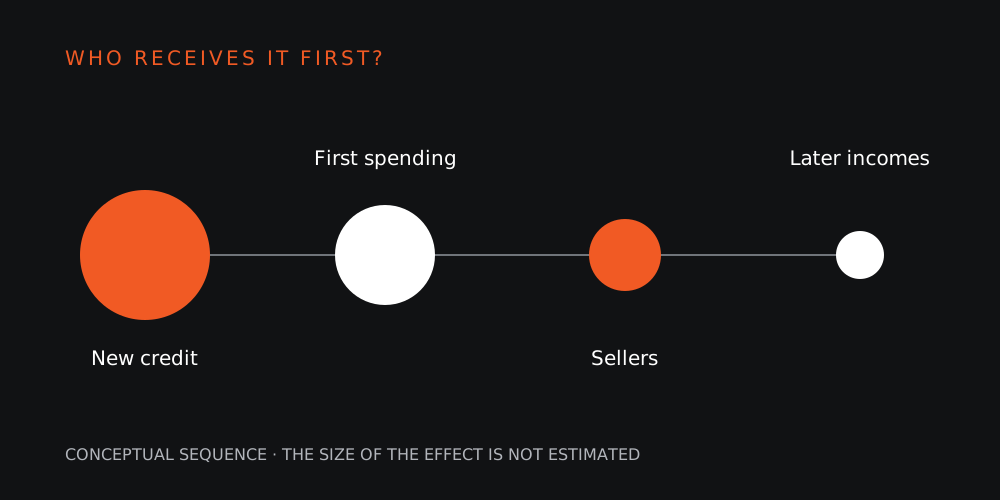
New money enters somewhere. It is spent by particular people on particular goods before every wage, price and contract can adjust. That route matters as much as the headline increase in a monetary aggregate.
The Cantillon effect names this distributional insight. Richard Cantillon traced different spending routes in his Essay on the Nature of Trade in General, part II, chapters VI–VII. The Austrian criticism of monetary expansion is not simply that an average price index may rise. It is that the adjustment can change relative prices and opportunities while different participants face different timing.
The mechanism is a sequence, not an equal windfall
Mises develops the non-neutrality argument in his monetary writings: changes in money affect prices and incomes at different times and to different degrees. A new unit is not automatically shared among everyone in proportion to their existing balance.
Imagine a newly financed buyer purchasing an existing asset. The seller receives the payment and spends part of it on other goods. Other incomes and contracts adjust later, if they adjust at all. The order of those transactions can matter to who can buy at which prices. This example illustrates a route; it does not measure an economy-wide effect or establish that the first buyer made a profit.
Follow the spending before judging the outcome

The banking mechanism is more precise than “printing”
The Bank of England explains that commercial banks create deposit money when they lend. The matching loan is an asset for the bank and a liability for the borrower; the deposit is a claim the borrower can spend. Creating a claim does not create an equal amount of real wealth.
Credit is constrained. As the Bank of England’s explainer sets out, banks need capital and financing and face monetary policy and regulation. Borrowers also need the capacity to service their obligations. Repaying principal reduces deposit money. These details matter because a monetary critique becomes less convincing when it describes every loan as an unlimited gift from a printing press.
A borrower who receives new financing also owes a debt. The economic advantage, if one exists, depends on borrowing terms, purchase prices, later income and competing bids. A low-cost borrower may gain purchasing opportunities that others do not have, while still making a poor investment.
The privilege question belongs in monetary analysis
The Satswise position: access to monetary expansion should be examined as an institutional advantage. It can favour participants with collateral, financial connections or a position close to the spending channel. The burden of an adjustment can arrive before another participant’s income changes.
The useful question is concrete: who receives the new claim, what do they buy, which contracts adjust, and which participants cannot change their terms? That question can be asked of bank credit, asset purchases or fiscal transfers. It cannot be answered by a money-supply chart alone.
Nor are the winners always the same. Transfers to households enter through a different route from loans secured on financial assets. A new spending programme and a refinancing operation should not be assigned an identical distributional result without studying their design.
Bitcoin changes issuance; crypto can recreate privileges
Bitcoin’s subsidy is distributed through mining under a public rule, rather than through a central committee choosing borrowers. This is an institutional difference, not proof that everyone has equal opportunities. Mining requires resources, existing holders have different acquisition costs, and access to financing can still shape demand for the coins.
Other crypto systems may grant early allocations, discretionary emissions, preferential access or token-funded yields. Our application of the non-neutrality lens is to inspect those arrangements: who can change supply, who receives new units, what must they give up, and who absorbs dilution?
A token marketed as an escape from fiat privileges should be held to that standard. Replacing a public monetary authority with an opaque token issuer does not automatically improve the holder’s position. Read how token economics can separate network use from holder value.
How to avoid making the argument unfalsifiable
Early recipients do not necessarily gain. Prices may already anticipate a policy, lenders may charge for inflation risk, borrowers may default, and spending can add to productive capacity over time. The sequence argument identifies channels; estimating welfare or wealth effects requires more information.
A lower purchasing power of unchanged cash is measurable against a named basket. A claim that a particular group became richer because of a particular policy requires household or firm-level evidence, a timing argument and a credible comparison. Our diagram does not perform that study.
Use the argument to improve the questions, then test the answers. Pair observed price-level erosion with a clearly stated transmission channel. Monetary criticism becomes more persuasive when it specifies what is known and what still needs to be established.
Sources and scope
Mechanism essay reviewed 12 October 2026. The transaction example and diagram are conceptual, with no estimated distributional effect. Applications to Bitcoin, token allocations and monetary privileges are Satswise’s editorial analysis. The essay does not identify a universal group of beneficiaries or treat all asset-price changes as monetary-policy effects.
- Mises — non-neutral money, relative prices and distribution
- Bank of England — the modern lending and deposit mechanism
- Bitcoin white paper — incentive and verification architecture
Updated 13 Oct 2026: Added a concise answer, evidence limits and topic reading paths. Underlying source reviews and chart observation cutoffs remain unchanged. Report a correction.