
Do hashprice and the Puell Multiple measure miner profit?
Hashprice estimates revenue per unit of computing power. The Puell Multiple compares the dollar value of issuance with its recent history. Profit also depends on operating and capital costs, so neither measure is a complete profit calculation.
Attributed definitions and invented operating scenarios; no current hashprice or Puell reading. Research methods.
What do Bitcoin miner indicators measure?
Bitcoin miner economics connects the revenue from securing the network with the costs of running the machines. Three measurements answer different questions: the block subsidy describes new issuance, the Puell Multiple compares the dollar value of issuance with its recent history, and hashprice estimates revenue for a unit of computing power. None is a complete measure of a miner’s profit.
For an investor, the useful question is whether a change in revenue could create financial pressure. Answering it requires the miner’s costs, financing and cash resources. A low indicator reading alone cannot establish that miners must sell bitcoin, or that the market has reached a price floor.
Block subsidy and fees are separate revenue components.
Bitcoin’s block reward combines newly issued coins, called the subsidy, with transaction fees from the included transactions. The subsidy halves every 210,000 blocks. Fees transfer existing bitcoin from users; they do not increase issuance. These protocol distinctions are described in the Bitcoin developer guide.
The Bitcoin supply guide explains why this schedule is more predictable than price. The next scheduled subsidy reduction is at block 1,050,000, from 3.125 to 1.5625 BTC per block. Its calendar date depends on when blocks arrive. A fee spike can partly offset a subsidy reduction in total revenue, so a halving does not automatically cut every miner’s dollar receipts in half.
What is the Puell Multiple?
Glassnode defines the Puell Multiple as daily bitcoin issuance valued in USD divided by the 365-day moving average of that daily issuance value. We use that issuance definition here: the newly issued subsidy, excluding transaction fees. A provider using total miner revenue instead would be measuring a different series and should state that choice.
Puell Multiple = daily USD issuance / 365-day average of daily USD issuance
In a hypothetical example, 450 newly issued BTC valued at $80,000 each gives $36 million of daily issuance. If the 365-day average for that date is $45 million, the multiple is 0.80. Another $4 million of fee revenue would raise total rewards to $40 million, but would not change the $36 million issuance numerator in this definition.
This distinction matters around halvings: fewer newly issued coins can reduce the numerator while the average still contains many days with a larger subsidy. Our interpretation is that a low ratio needs a revenue explanation before it becomes a distress explanation. It says nothing directly about a particular operator’s electricity tariff or debt payments.
What is Bitcoin hashprice?
Luxor’s Bitcoin Hashprice Index estimates the daily value earned by 1 petahash per second of computing power. USD hashprice is commonly expressed as dollars per PH/s per day; BTC hashprice uses bitcoin instead of dollars. One PH/s equals 1,000 TH/s.
Luxor’s definition incorporates the subsidy, fees and network difficulty; the USD version also incorporates Bitcoin’s price. Its fee input uses a trailing 144-block average. Compare providers’ averaging conventions before comparing readings. Hashprice describes revenue capacity, while machine efficiency and electricity costs determine how much of that revenue remains.
Small changes can compress the cash remaining.

Satswise arithmetic example. This is not an observed hashprice series or a miner profit estimate.
How do efficiency and electricity change the result?
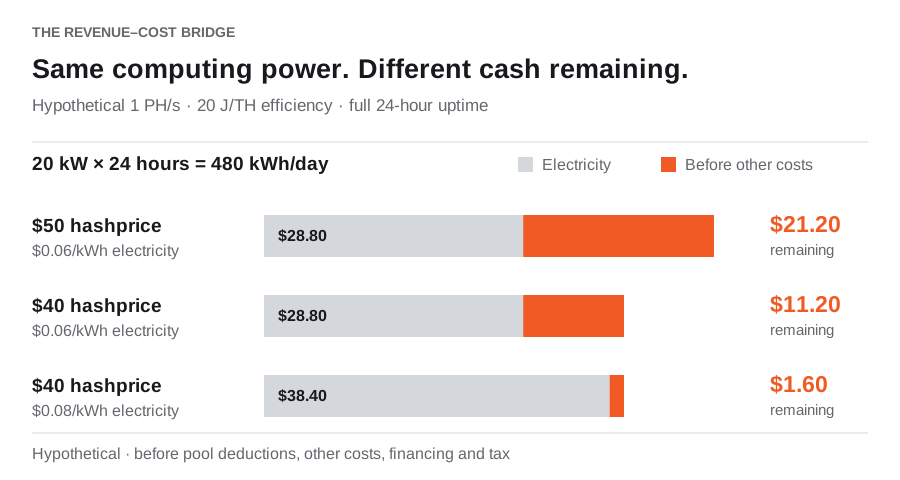
Assume a machine or fleet produces 1 PH/s at an efficiency of 20 joules per terahash. The power draw is 1,000 TH/s × 20 J/TH = 20,000 watts, or 20 kW. Over 24 hours it consumes 480 kWh. At $0.06 per kWh, electricity costs $28.80 per day.
| Scenario | Gross revenue | Electricity cost | Remaining before other costs |
|---|---|---|---|
| $50 hashprice; $0.06/kWh | $50.00 | $28.80 | $21.20 |
| $40 hashprice; $0.06/kWh | $40.00 | $28.80 | $11.20 |
| $40 hashprice; $0.08/kWh | $40.00 | $38.40 | $1.60 |
A 20% revenue reduction almost halves the first scenario’s residual: $21.20 becomes $11.20. That is operating sensitivity, not evidence that Bitcoin’s price will fall 20%. The electricity-only break-even hashprice in the first two scenarios is $28.80 per PH/s per day. A complete break-even estimate must add every cost it claims to cover.
How should investors read miner pressure?
The Cambridge mining industry report finds electricity dominates surveyed miners’ cash operating expenses. Its historical survey is context, rather than a universal cost assumption for every operator today.
Our reading order starts with the revenue change, then the operator’s efficiency and power contracts, then other operating and capital commitments. Finally, examine liquidity and any evidence of actual sales. A miner can fund a cash gap by selling coins, drawing reserves, borrowing or issuing equity; the indicator itself does not reveal which response occurred.
Keep this operating analysis separate from the 200-day average and Mayer Multiple, which describe price history. Miner revenue stress can inform a cycle argument when a plausible financing mechanism connects it to supply. It cannot replace evidence about demand.
The subsidy falls at each halving

Sources, assumptions and scope.
Knowledge article reviewed on 12 October 2026. Definitions are attributed to their providers. All dollar amounts, issuance inputs and operating scenarios above are invented examples; no current Puell or hashprice observation is presented. Calculations assume constant efficiency, full uptime and electricity billed per kWh. The diagrams and interpretation are Satswise’s original work.
- Bitcoin developer guide — Block subsidy and transaction fees
- Glassnode — Puell Multiple definition
- Luxor — Hashprice definition and methodology
- Cambridge Centre for Alternative Finance — Digital Mining Industry Report
Updated 13 Oct 2026: Added a concise answer, evidence limits and topic reading paths. Underlying source reviews and chart observation cutoffs remain unchanged. Report a correction.